Showing posts with label Updates. Show all posts

Monday, January 22, 2018

ANWR update


Back in 2002, annoyed at shoddy reporting on the oil potential in the Arctic National Wildlife Refuge, ANWR, (more specifically the "1002 Area"), I did some research followed by a brief write-up. In March 2008 I reprinted my write up along with a brief update; followed by a further update a few weeks later (note: scroll down to the second story). 

Arctic National Wildlife Refuge (ANWR): An Overview was just published this month by the Congressional Research Service (CRS 26-page PDF). 

“In the ongoing energy debate in Congress, one recurring issue has been whether to allow oil and gas development in the Arctic National Wildlife Refuge (ANWR, or the Refuge) in northeastern Alaska.  ANWR is rich in fauna and flora and also has significant oil and natural gas potential. Energy development in the Refuge has been debated for more than 50 years. On December 20, 2017, President Trump signed into law P.L. 115-97, which provides for an oil and gas program on ANWR’s Coastal Plain. The Congressional Budget Office estimated federal revenue from the program’s first two lease sales at $1.1 billion, but actual revenues may be higher or lower depending on market conditions and other factors. This report discusses the oil and gas program in the context of the Refuge’s history, its energy and biological resources, Native interests and subsistence uses, energy market conditions, and debates over protection and development…”

This clearly is more comprehensive than my write-up, which only discussed the amount of oil and not the ecological, social, and other aspects of the issue. The report's conclusion?  

"Enactment of P.L. 115-97 in December 2017 culminated a decades-long debate over whether to allow oil and gas development in ANWR in northeastern Alaska. The law established an oil and gas program for the Refuge’s Coastal Plain, with at least two oil and gas lease sales required in the next 10 years. Development proponents contend that the sales will generate economic activity, contribute to U.S. energy security, and result in royalty revenues for both the federal government and the State of Alaska, while opponents express concern that development will detrimentally impact the unique biological resources of the Refuge. 

P.L. 115-97 requires the first ANWR lease sale within four years of the law’s enactment. Activities preparatory to the lease sale include identifying lands to be leased, conducting sale-specific environmental reviews, issuing notices of sales, and other “prelease” activities. Activities could also include new geological and geophysical (G&G) surveys to determine the extent and location of hydrocarbon resources. 

Congress could potentially take additional action related to ANWR oil and gas leasing , including through further legislation or through oversight of DOI’s implementation of the provisions of P.L. 115-97.  A number of development issues addressed in earlier ANWR bills were not addressed in P.L. 115-97, possibly owing in part to limitations imposed by the budget reconciliation process. Congress could choose to address some of these issues in future legislation amending the oil and gas program or could decide that the provisions of P.L. 115-97 already provide sufficient guidance for the program. Alternatively, Congress could decide to end the program, for example by designating the Refuge’s Coastal Plain as wilderness, as is proposed in some 115th Congress bills. 

The Congressional Budget Office estimated the state and federal revenue from the first two lease sales in ANWR at approximately $2.2 billion over 10 years. Actual bids will depend on many factors, including market conditions at the time of the lease sales. Development and transportation of oil in the Refuge, as elsewhere in the Arctic, is a difficult and expensive prospect, and a key factor in industry bids will be the price of oil."


Monday, October 27, 2014

As was manifestly clear even then...


The 'Yawn!' blog entry from March 2010 looked at the New START agreement and was singularly unimpressed despite it being touted by President Obama as "... the most comprehensive arms control agreement in nearly two decades..." which demonstrated that "... the United States and Russia -- the two largest nuclear powers in the world - also send a clear signal that we intend to lead. By upholding our own commitments under the Nuclear Non-Proliferation Treaty, we strengthen our global efforts to stop the spread of these weapons, and to ensure that other nations meet their own responsibilities."

A recent article 'New START: Russia and the United States Increase Deployed Nuclear Arsenals' notes that "... Three and a half years after the New START Treaty entered into force in February 2011, many would probably expect that the United States and Russia had decisively reduced their deployed strategic nuclear weapons.

On the contrary, the latest aggregate treaty data shows that the two nuclear superpowers both increased their deployed nuclear forces compared with March 2014 when the previous count was made.

Russia has increased its deployed weapons the most: by 131 warheads on 23 additional launchers. Russia, who went below the treaty limit of 1,550 deployed strategic warheads in 2013, is now back above the limit by 93 warheads. And Russia is now counted – get this – as having more strategic warheads deployed than when the treaty first went into force in February 2011! ..."

Not a real shock for anyone paying attention!

Monday, September 1, 2014

MLR overview


Some previous blog entries referencing the MLR:
Update III - MLR update - Aug 9th, 2014
MLR - Year 2 - Jun 22, 2013
Latest MLR update -  Dec 4th, 2011
The MLR saga continues - May 13th, 2011
Misc update (MLR) - Mar 26th, 2011
Misc update - V - Feb 13th, 2011
Misc updates - MLR - Oct 25th, 2010
MLR Redux - Aug 24th, 2010
MLR update - Jun 27th, 2010


Medical Loss Ratio Requirements Under the Patient Protection and Affordable Care Act (ACA): Issues for Congress provides a nice overview of the medical loss ratio, including:

"The 2010 Patient Protection and Affordable Care Act (ACA, P.L. 111-148) requires certain health insurers to provide consumer rebates if they do not meet a set financial target known as a medical loss ratio (MLR). At its most basic, a MLR measures the share of health care premium dollars spent on medical benefits, as opposed to company expenses such as overhead or profits. For example, if an insurer collects $100,000 in premiums and spends $85,000 on medical care, the MLR is 85%. In general, the higher the MLR, the more value a policyholder receives for his or her premium dollar. The ACA requires an annual, minimum 80% MLR for individual and small group insurance plans, and an annual, minimum 85% MLR for large group plans. Congress imposed the MLR to provide “greater transparency and accountability around the expenditures made by health insurers and to help bring down the cost of health care.”...

"... The ACA statute and regulations allow companies to include both quality improvements and medical services when calculating total MLR medical spending. Insurers may subtract (i.e., disregard) state and local taxes and some licensing fees from total MLR expenses... The ACA MLR is now the national minimum standard that must be met by covered health insurers..."

"... The MLR provisions apply to fully funded health plans, which are plans where insurance companies assume full risk for incurred medical expenses. The MLR does not extend to self-funded plans... Non-profit insurers and Medicare plans were not subject to the MLR during the first two years the ACA was in effect... The HHS granted three-year MLR waivers to select states where it determined that MLR implementation could harm the individual insurance market..."

"In general, the higher the MLR, the more value a consumer receives for each dollar of paid premium. For example, an 85% MLR means that 85% of premium dollars paid into a plan are paid out in the form of benefits. A 75% MLR means that just 75% of premium dollars are used for benefits. The MLR is an aggregate measure. Because the ratio is based on a health plan’s overall performance, some enrollees may pay more in premiums during the course of a year than they receive in benefits, while others may receive benefits that far exceed their premium payments..."

"... The ACA MLR standards require that covered insurers in the individual and small group markets meet a minimum MLR of 80%. For insurers that sell large group plans, the minimum MLR is 85%. The higher MLR requirement for the large group market accounts for economies of scale; in other words, it is more efficient to sell insurance to a large company that will offer coverage for many individuals and families than it is to have to market a product to one individual at a time, or to firms that cover a smaller group of individuals. Thus, the higher MLR standard for large companies reflects their assumed lower administrative costs..."

"... Definition of Medical Claims: Incurred claims = direct claims incurred in MLR reporting year + unpaid claim reserves associated with claims incurred + change in contract reserves + claims-related portion of reserves for contingent benefits and lawsuits + experience-rated refunds (exclude rebates based on issuers MLR)..."

"... The ACA allows insurers (with some exceptions) to include spending for quality improvements in the numerator for calculating the MLR. In other words, companies can meet the federal MLR medical claims requirement, in part, by increasing activities designed to enhance the quality of their insurance products. Thus, the actual definition of what constitutes a quality expenditure is important to the MLR calculation..."

"... Final HHS rules let insurers count money recovered from fraud and abuse initiatives toward the MLR requirement for medical benefits spending, but do not allow companies to count broader fraud prevention activities..."

"... A key part of the MLR calculation is the definition of premiums, which is in the denominator of the MLR formula. Holding medical claims and quality improvement constant, an increase in premium revenues lowers the MLR, while a reduction in premium revenues raises the MLR. The ACA also allows insurers to subtract certain taxes, licensing, and regulatory fees from premiums, which can further increase the MLR amount (and reduce the likelihood of paying rebates)..."

"... Premiums are calculated based on earned premiums, and are defined as the sum of all monies paid by a policyholder in order to receive coverage from a health insurer... Taxes, licenses, and regulatory fees are subtracted from premiums under the MLR formula. Since they reduce premium revenue, higher taxes and fees can raise the MLR... Federal taxes are defined by HHS as all federal taxes and assessments allocated to health insurance coverage that are subject to the MLR reporting requirements under ACA. Federal income taxes on investment income and capital gains are excluded from this component as they are not considered taxes on premium revenues and, thus, should not be used to adjust premium revenues..."

"... The ACA requires that the MLR calculation include methodologies to account for the special circumstances of smaller plans, different types of plans, and newer plans. To that end, the NAIC recommended, and HHS adopted, two “credibility adjustments” designed to address issues associated with random variation in claims data... The first credibility adjustment is intended to address health insurance plans with low enrollment... A second credibility adjustment is available to insurers that have a large share of high deductible health plans (HDHPs)..."

"... The ACA gave the HHS Secretary the authority to adjust the 80% MLR standard for the individual health insurance market if the Secretary determined that applying the standard could destabilize the individual market in a given state. States were allowed to request a temporary adjustment in the MLR ratio for up to three years, to avoid coverage disruptions in their individual markets... Seven states were granted an adjustment: Georgia, Iowa, Kentucky, Maine, Nevada, New Hampshire, and North Carolina. Ten states and a territory were denied an adjustment: Delaware, Florida, Guam, Indiana, Kansas, Louisiana, Michigan, North Dakota, Oklahoma, Texas, and Wisconsin..."

"... Health insurers that fail to meet the minimum MLR requirements must provide rebates to policyholders... The NAIC recommended, and HHS agreed, that the entity distributing the rebates may choose whether to disburse payments to current enrollees as a lump-sum check or a deposit to a credit or debit card..." 


Sunday, August 17, 2014

Follow-up - drug side-effect suits


Some previous blog entries related to pharma suits:
Misc update (pharma suits) - Mar 26th, 2011
Misc update III - Feb 13th, 2011
Say what? - Aug 25th, 2010
Wyeth v. Levine - Mar 22nd, 2009

Previous blog entries, see links above, had looked at suits related to drug side effects and manufacturers' 'duty to warn.' One entry referenced 'Wyeth vs. Levine', in which Diana Levine sued Wyeth and prevailed on 'pre-emption' (against the trade-name drug manufacturer), while  another referenced 'Mensing' in which Gladys Mensing sued Actavis on 'pre-emption' (against the generic manufacturer) and ultimately lost.

However, in both cases the plaintiffs sued the actual manufacturer of the drug that they were taking. Now, however, the Alabama Supreme Court has upheld its ruling that a plaintiff can sue the trade name manufacturer when they actually used drug made by a generic manufacturer... Read this for their reasoning...

Saturday, August 9, 2014

Update IX - Georgia update


Some previous blog entries on Georgia:
Five Years On -  Aug 4th, 2013
Misc update - Georgia -  Jun 1st, 2013
Misc update (Georgia) - May 18th, 2012
Misc update (Georgia) - Dec 28th, 2011
Misc update (Georgia) - May 15th, 2011
Misc update (Georgia) - Mar 26th, 2011
A little war II - Apr 22nd, 2010
A little war I - Mar 17th, 2010
An inconvenient truth - Nov 26th, 2008
Georgia update... - Nov 22nd, 2008
Georgia - Sept 7th, 2008
Immediate Response?!? - Aug 25th, 2008
Georgia (updated) - Aug 15th, 2008

Criminal Charges Filed Against Saakashvili - "... Georgian prosecutor’s office said on July 28 that it filed criminal charges against former president Mikheil Saakashvili. Prosecutor’s office said that charges of exceeding official authorities stem from breaking up of the November 7, 2007 anti-government protests, as well as raid on and “seizure” of Imedi TV station and other assets owned at the time by tycoon Badri Patarkatsishvili, who died in February, 2008. Prosecutor's office said decision was made to also file same charges against Vano Merabishvili, who was interior minister in 2007; then chief prosecutor Zurab Adeishvili; then defense minister Davit Kezerashvili and Gigi Ugulava, who at the time was Tbilisi mayor..."

Update V - emergency response

Previous blog entries on the marathon bombing medical response:
Follow-up (lessons learned) - Aug 20th, 2013
The Right Lesson? - Jun 9th, 2013

The examination of what happened as part of the medical response continues, and additional lessons are being drawn, see Researchers assess emergency radiology response after Boston Marathon bombings

Update II - "shadow commander"

The July 7th, 2014 blog entry 'Recycle...' discussed the "shadow"commander of Iran's Quds Force, General Qassem Suleimani.  

IRGC-QF Maj. Gen Soleimani, as young commander during Iran-Iraq War has extensive pictures of the "shadow commander" that "no one's ever heard of."

Update I - manufacturing

The December 19th, 2009 blog entry 'Drivel' took issue with the 'manufacturing in the U.S. is in complete decline' meme.

A recent (July 2014) CRS article, Measuring the Loss of Manufacturing Jobs,explains that manufacturing job loss data "... suggest that the United States is not an outlier when it comes to losing factory jobs...Over the entire period between 1991 and 2012, the most recent year for which comparative data are available, the United States shed 23.7% of its manufacturing jobs. This was a smaller percentage decline than that experienced by many peer economies, including France, Germany, Japan, the Netherlands, Sweden, and the United Kingdom..." 


However, the decline in manufacturing jobs does not translate into a decline in manufacturing. The article 'US manufacturing base is surprisingly strong' looks beyond the employment data and points out that:

"... the overall size of the US industrial base – real value-added in manufacturing – has been growing rapidly for more than four decades, and is on track to surpass the all-time 2006-7 high before the end of 2014..."

"...Real value-added in manufacturing grew by 3.1% per year over the entire period 1960-2007, and after a dip during the recession recovered with 4% per year growth from 2010 through 2013. Even with a growth rate no higher than 2.8% per year, the absolute size of the US industrial base – total value-added in manufacturing – will surpass the all-time 2006-2007 high before the end of 2014..."

and

"...  A careful look at the most recent and detailed data shows that despite falling employment, the US manufacturing base is growing larger, more productive, and more competitive."

Monday, February 10, 2014

Latest drug shortage update


Today the Health Subcommittee of the House Energy and Commerce Committee held a hearing on 'Examining Drug Shortages and Recent Efforts to Address Them.' See video here...


The testimony  from the GAO and FDA discussed the issue, quantified it, and spoke of efforts to combat drug shortages...The main reasons cited (GAO) for shortages? "... quality problems resulting in supply disruptions and constrained manufacturing capacity...", suggestions that "... changes in FDA inspections of manufacturing establishments also played a role...", and "... a number of additional factors that can cause supply disruptions and ultimately result in shortages —such as permanent product discontinuations or the unavailability of raw materials."  

The reason for all the quality problems? GAO testimony mentioned studies that point towards "...underlying causes generally suggested that such causes led to low profit margins, which limited infrastructure investments or led some manufacturers to exit the market." And when one manufacturer has a problem there usually isn't enough spare capacity in the system for the (few) others to make up...

The GAO's recommendations?  That the FDA "develop policies and procedures for the use of the existing drug shortages database (and, ultimately, the new drug shortage information system) to ensure staff enter information into the database in a consistent manner and to ensure the accuracy of the information in the database; and,conduct periodic analyses using the existing drug shortages database(and, eventually, the new drug shortages information system) to routinely and systematically assess drug shortage information, and use this information proactively to identify risk factors for potential drug shortages early, thereby potentially helping FDA to recognize trends, clarify causes, and resolve problems before drugs go into short supply."

Recommendations that may be characterized as fairly "generic."

The main reasons cited (FDA) for shortages? "... In 2012, for example, based on information collected from manufacturers, FDA determined that 66 percent of production disruptions leading to a shortage resulted from either (1) efforts to address product-specific quality problems (31 percent) or (2) efforts to address broader problems at a manufacturing facility (35 percent)." Also mentioned: product discontinuations (for economic reasons), natural disasters, and problems with raw materials availability... 

Finally, beyond working on measures to improve their response when shortages are already on their way (when the FDA is notified of production disruptions), the FDA is also looking for longer-term fixes, e.g. "... a focus on encouraging and sustaining improvements in manufacturing quality... encouraging development of techniques that can help advance drug manufacturing... actions to encourage manufacturers to adopt new manufacturing technologies, to facilitate their use of modern quality management techniques, and to ensure that FDA regulatory policies reflect state-of-the-art manufacturing science..."


Previous blog entries on drug shortages: 
A drug shortage comment - Jan 11th, 2014 
Drug shortages - update - Nov 21st, 2013
Random charts - drug shortages -  Aug 10th, 2013
Follow up (drug shortages) - Jul 5th, 2013
Random charts - drug shortages - Jan 31, 2013
Random charts - drug shortages - Jul 25th, 2012
Diagnosis - muddled thinking - Jan 21st, 2012
Polarization? - Dec 2nd, 2011
Help on the way? - Jul 31st, 2011
Random charts - Apr 6th, 2011

And a 2011 reprint of a 2002 entry with a dozen  real-life examples of reasons for drug shortages:

The why's of drug shortages - Mar 30th, 2011

Wednesday, January 29, 2014

Update - Tower of David


The Oct 20th, 2013 blog entry 'Random picture - Tower of David' showed a picture of the "Tower of David" - described as: ".... a looming and dilapidated structure that he describes as “a ziggurat of mirrored glass topped by a great vertical shaft, [rising] forty-five stories above the city.” The Tower, which can be seen from almost anywhere in Caracas, is a symbol of the downward spiral that Venezuela has experienced under Hugo Chávez’s rule." Slumlord described "... the world's tallest slum..." and a place "... of prison-style executions, of people being mutilated and their body parts thrown off the upper floors." 

Now 'A Tower Transformed' puts it in a much more positive light, as "... a complex and fascinating place: not just a symbol of poverty, but a symbol of the self-organized activity that offers a way out of poverty. It isn't the development that David Brillembourg envisioned, but it isn't a Ballardian hellscape either. It's more of a messy testimonial to human creativity and survival: ragged, flawed, inventive, and amazing."

Tuesday, January 7, 2014

Confirmed! (Powell & torture)


Earlier blog entries (see below) had looked at Colin Powell related to the "Iraqi WMD" imbroglio and his knowledge re the use of 'enhanced interrogation tactics" (EITs, more commonly known as torture).

In the case of the first he acknowledge mistakes being made, but worked diligently over the years to transition from his initial 'I verified all the allegations myself' version to the current 'we need to ask the CIA and DIA why the source's unreliability wasn't identified before false information was put into my presentation to the UN'  Note especially the artful, and 3rd person, "put into."

On the torture issue Powell kept quiet while his aide Colonel Wilkerson stated multiple times that he had not been in the loop on EIT...This was first shown to be false by a Senate committee report. When asked re this Colin Powell had to resort to torturing the English language - stating that he didn't have "sufficient memory recall" about the meetings referenced; that he had participated in "… many meetings on how to deal with detainees…”; and that he was not "aware of anything that we discussed in any of those meetings that was not considered legal…”

Now with the CIA's former top lawyer John Rizzo speaking publicly about EIT we have further proof, were it really necessary, that Colin Powell was fully in the know. Colin Powell and Colonel Wilkerson confirmed as bald faced liars...


Previous blog entries concerning Colin Powell:
Great quotes ... - Feb 21, 2011
Random picture - December 22nd, 2010
Powell... Tekel... - April 15th, 2009
And yet... - December 14th, 2008
As expected... - October 20th, 2008
The Powell rehabilitation project? - July 13th, 2008
Did they say that (III) - April 20th, 2008

Saturday, January 4, 2014

Random chart - unemployment


"... The following graph shows the percentage of payroll jobs lost during post WWII recessions through November. The economy has added 8.1 million private sector jobs since employment bottomed in February 2010 (7.45 million total jobs added including all the public sector layoffs). There are still almost 760 thousand fewer private sector jobs now than when the recession started in 2007..."

Saturday, November 16, 2013

'So, how bad is it?' update


The blog entry from October 20th, 2013 included a look at a study of the compensation of hospital executives. A quick reminder of the relevant portion of the blog entry follows:
"Another recently issued study, also by Dr. Jha, looked at hospital CEO pay and examined if  the level of pay was related to quality metrics. It concluded that they were not related and that while pay was "associated with" the number of hospital beds, whether the organization was a teaching hospital, its location (rural vs. urban), the amount of technology, and patient satisfaction, "... we found no association between CEO pay and hospitals’ margins, liquidity, capitalization, occupancy rates, process quality performance, mortality rates, readmission rates, or measures of community benefit." This reverberated like a bombshell in the news and the blogosphere, leading to thousands if not tens of thousands of articles such as 'Care, CEO pay not linked, study says.'  A closer reading of the study showed that a) they looked at the hospital quality metrics, community benefit, etc. numbers from 2008 and CEO pay from 2009, and that, b) the measures  chosen to be the proxy for 'quality' were a fairly limited subset of quality measures - "... composite measures of performance on processes of care for acute myocardial infarction, congestive heart failure, and pneumonia... from which we built patient-level hierarchical logistic regression models to calculate 30-day risk adjusted mortality and readmission rates..." It has been argued that the choice of metrics could have influenced the outcome... While this blogger certainly doesn't have the expertise to know if this is true, or to understand the effect this choice had on the outcome of the study, it is certainly clear to him that perhaps two of the three measures would seem to be less applicable to the quality efforts of, for example, children's hospitals!  True, an argument certainly can be made that Dr. Jha and his co-authors bear  no responsibility for the tsunami of articles stating that hospital  CEO salaries have no relationship at all to quality of care and medical outcomes, when in fact the evidence is more nuanced and, at best, was the case in 2008 i.e. five years ago... However, this blogger is focused (as is clearly stated above) on the "uncritical and megaphone treatment" of some studies, clearly present in this case!. "
Well, in the discussion I noted that there had been some push back on the choice of metrics, but that I personally don't have "... the expertise to know if this is true, or to understand the effect this choice had on the outcome of the study..." Here is an additional data point. In all fairness to Dr. Jha's choice of "... composite measures of performance on processes of care for acute myocardial infarction, congestive heart failure, and pneumonia..." his choice of a narrower set of just three outcome measures is supported by a study that found that a composite of these three measures do track fairly well with a much broader array of measures and that it can be used as a reasonable proxy for the same! Note: this does not detract from the fact that this is not applicable to all hospitals e.g. children's hospitals, or the larger point that I was trying to make... However, credit is due where credit is due!

Saturday, June 1, 2013

Misc update - Georgia


The Russia: Other Points of View blog had a recent entry on... Georgia. 'Georgian Reflections' has a nice overview of the history/situation (with many links).

Some previous blog entries on Georgia:
Misc update (Georgia) - May 18th, 2012
Misc update (Georgia) - Dec 28th, 2011
Misc update (Georgia) - May 15th, 2011
Misc update (Georgia) - Mar 26th, 2011
A little war II - Apr 22nd, 2010
A little war I - Mar 17th, 2010
An inconvenient truth - Nov 26th, 2008
Georgia update... - Nov 22nd, 2008
Georgia - Sept 7th, 2008
Immediate Response?!? - Aug 25th, 2008
Georgia (updated) - Aug 15th, 2008
Two-edged sword (South Ossetia) - Aug 11th, 2008

Sunday, July 31, 2011

Misc update (psyops)

Click to enlarge

The February 25th, 2011 blog entry 'Much ado?' noted the controversy caused by a Rolling Stone article that claimed that 3-star Lt. Gen. William Caldwell (responsible for the training of Afghan troops) had "... illegally ordered a team of soldiers specializing in "psychological operations" to manipulate visiting American senators into providing more troops and funding for the war, Rolling Stone has learned – and when an officer tried to stop the operation, he was railroaded by military investigators..." and went on to try and understand the differences between the terms 'Information Operations', 'Psyops', 'Public Affairs', etc. (which most commentators seemed to used somewhat interchangeably)

Well, following an internal investigation it is reported that the DoD Inspector General has agreed with the investigation's conclusion that the psyops charges were not substantiated... The second allegation, that Lt. General Caldwell retaliated against the Lt. Colonel who pushed back is still open and the subject of a separate investigation...


Misc update (mega-tsunami)


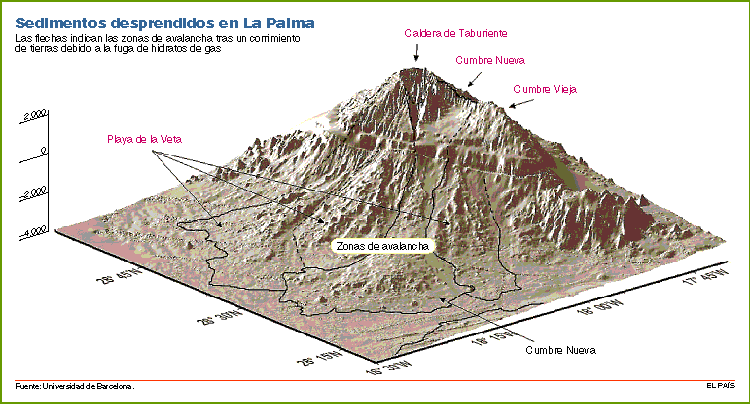
An article 'More Than 720 Earthquakes Recorded On El Hierro In One Week' informs us of an earthquake sward in the Canary Islands, on the island of El Hierro situated to the south of the island of La Palma. This is the location of a volcano that some have theorized could create a mega-tsunami at some point in the future... Others feel the possibility is over-hyped, while still others claim it is the work of charlatans... Whether true or false, likely or unlikely, it sure has generated tons of publicity and lurid headlines, and was even featured by this blogger (see below:)


Reprint of OPED25 of 06/24/2002:

In July 1958 in Lituya Bay, Alaska, an earthquake struck measuring around 8 on the Richter scale. This triggered a collapse in which an estimated 40 million cubic yards of dirt slid into the bay, which in turn generated a massive wave that devastated the area. From the height to which all trees were denuded off the slopes it is estimated that the wave was a staggering 1,720 feet high at its highest point.

Some references to Lituya Bay: Mega-Tsunami. Charles L. Mader - Biggest Wave - Lituya Bay Tsunami - Lituya Bay Close-Up

Mega-tsunamis are gigantic waves up to and exceeding 100 feet that can be triggered by similar events. Evidence of past mega-tsunamis exists in various places around the globe. For example, in the Bahamas there are 123,000 year old deposits including boulders weighing up to 2000 tons that are up to 20 meters above sea level and at least half a kilometer inland. These are theorized to have been deposited by a mega-tsunami caused by the El Golfo I collapse in the Canary Islands.

Now, scientists have identified a fault in the Canary Islands that sometime in the future could perhaps cause a mega-tsunami. The Cumbre Vieja volcano is found on La Palma in the Canary Islands. La Palma is one of the steepest islands in the world, as well as being the most active volcanic island in the Canaries. In 1949 an eruption caused a fault to occur on the flank of the volcano, and the entire west flank of the volcano moved 4 meters seaward before stopping. Since then there has been no further movement, but it is anticipated that eventually during future eruptions there will be a collapse. A chunk of the island the size of the Isle of Man will fall into the sea creating a mega-tsunami. Scientists have attempted to computer-model the results... one model suggests that following this event the main wave would travel westwards, reaching the east coast of the Americas six hours later, at which time the wave will still be an estimated 100-150 feet high, causing unimaginable damage.

A few relevant links (a Google search shows hundreds of news reports):
Scientists are monitoring and studying Cumbre Vieja and caution that this should not happen for hundreds or perhaps even thousands of years, but that it will happen eventually. This writer has no idea of the technical issues involved (i.e. if this is a danger or not) but given the massive media exposure these reports were given and the lurid headlines (e.g. see above links) it would be a good idea to keep an eye on the area from a security standpoint in case terrorists try to trigger this event with a nuclear device.

Brief update (Honduras)

Some updates to the 'Mel and Honduras' story: In May all remaining court charges against Manuel Zelaya were dropped, followed swiftly by the signing of an agreement between him and the Honduran government allowing him to return to Honduras. This occurred at the end of May 2011, ending his approximately 16-month stint in exile. "The end of the former cattle rancher's 16-month exile was part of a deal brokered by several Latin American governments that will end Honduras diplomatic isolation and give the government of President Porfirio Lobo access to foreign investment and aid. The ousted former president is returning to lead the National Popular Resistance Front (FNRP), a movement formed after the June 2009 coup to challenge a two party system that has dominated Honduran politics since the early 20th century"

Previous blog entries on this subject:
No surprise - November 7th, 2009
Getting to agreement - November 29th, 2010

Help on the way?


The March 30th blog entry, 'The why's of drug shortages', introduced the issue of drug shortages and provided some statistics re how bad the problem has become over the last few years. The issue has been polemicized, with many making arguments based on widely-different views, for example from 'Got Meds? Not Necessarily, Say U.S. Hospitals' ("deeper, more hidden reasons" responsible... implying malfeasance by manufacturers and suppliers) to 'Rx Drug Shortages: Regulation Can Be Deadly' (faulting excessive government regulatory intervention...).

Some of our worthy Senators pop up in the news every time a drug shortage occurs and hits the newspapers, a prime example being Senator Amy Klobuchar (D-Minnesota), see:

Klobuchar asks FDA for solution to chemo drug shortage
Klobuchar seeks to ease medication shortage
Klobuchar Addresses Medication Shortages
Klobuchar Urges FDA to Address Shortage of Shingles Vaccine

... and she has introduced legislation on the subject. S296, the 'Preserving Access to Life-Saving Medications Act'. A number of groups (the American Society of Anesthesiologists, American Society of Clinical Oncology, American Hospital Association, Institute for Safe Medication Practices, and the American Society of Health-System Pharmacists) also wrote a letter in support of S296.

So what does S296 do? It requires pharmaceutical manufacturers to notify the FDA six months in advance of planned interruptions, disruptions, or discontinuations of drug supplies; and as soon as possible following unplanned ones. The HHS Secretary is mandated to develop the reporting mechanisms and develop monetary penalties for reporting failures; as well as to identify which drugs might have shortages, in which case he/she then also needs to work with the manufacturers to "address" the shortages...

A good question to ask might be if this legislation actually addresses any of the multiple reasons that cause drug shortages... This blogger would argue that the answer is 'no'. While frustrating for practitioners to never know in advance what shortages are impending, the mere addition of possible earlier notifications to the current situation will prove of limited utility, and in many cases will exacerbate the problem (since the reflex action of any hospital's Pharmacy purchasing staff will be to 'advance buy' as much of the drug as possible before it goes on back-order!!)


S296 - ‘‘Preserving Access to Life-Saving Medications Act’’
ASA BRief summary: S.296 - Preserving Access to Life-Saving Medications Act

Sunday, July 24, 2011

Brief update (Afghan fauna)

Picture credit: Gallo/Getty. Full picture here...

OPED 13 - Unnoticed victims in Afghanistan, from 2002, observed that "Though you'd be hard-pressed to find it in the news, other things equally devastated by Afghanistan's decades of war are the flora, fauna, and the environment of the country. The problems these face have a direct impact on the future of the country, and their deterioration will complicate and hinder the recovery and rebuilding process..." Among the victims it noted the snow leopard, endangered because their pelts command enormous sums...

A June 27th, 2008 update noted that "... the few remaining mountain leopards left in Afghanistan face another threat -- foreigners involved in rebuilding the war-torn country..."

But now some better news: a report that the Wildlife Conservation Society has found "...a surprisingly healthy population of snow leopards... in northeastern Afghanistan’s Wakhan Corridor..."